Hudson River
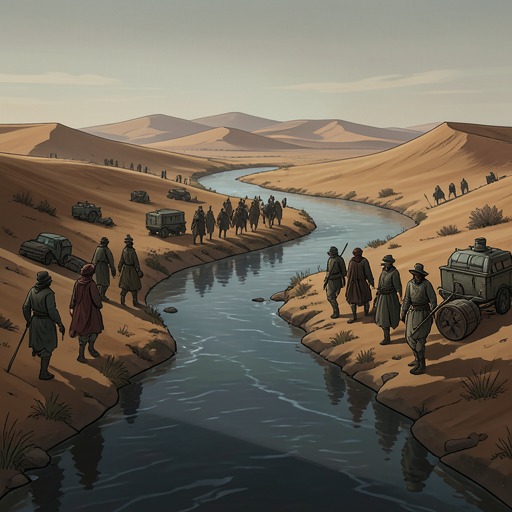
A Princess of MarsThe Hudson River setting frames the final earthly scenes of John Carter’s life: from a cottage bluff overlooking the river, he repeatedly reaches toward the heavens, and there he is later found dead in the snow. The familiar spot turns an unexplained private gesture into a clue and gives the river landscape a central place in the story’s mystery.
The Cottage Above the River
After returning from years away, John Carter stayed with his relatives for about a year before moving to New York. He bought a small, beautiful cottage on a bluff overlooking the Hudson River. The narrator visited once a year while traveling to the New York market, and during a visit in the winter of 1885 found John Carter much occupied with writing, which the narrator later presumed to be his manuscript.
The cottage was both a home and the setting for John Carter’s guarded preparations. He gave the narrator a key to a compartment in the safe in his study, explained that it held his will and personal instructions, and asked the narrator to carry them out faithfully if anything happened to him. The river bluff stood immediately beyond this private interior, joining the secrets kept in the study to the strange behavior visible outside.
The Repeated Gesture
On one night after retiring, the narrator saw John Carter standing in the moonlight at the edge of the bluff, arms stretched toward the heavens as though appealing to them. The narrator initially took the posture for prayer, while noting that John Carter did not seem religious in the strict sense. The gesture’s purpose remained unknown; its recurrence made the bluff a place of persistent, unanswered longing rather than an ordinary scenic overlook.
The landscape also sharpens the contrast between John Carter’s public manner and his solitary one. In company he remained genial and happy, but alone he could sit for hours gazing into space with a look of wistful longing and hopeless misery. Seen against the open sky above the river, the outstretched arms give that concealed distress a visible form without explaining its cause.
Discovery at the Bluff
On March 4, 1886, the narrator arrived at John Carter’s property after receiving a telegram asking him to come at once. A watchman from adjoining grounds had found John Carter dead shortly after daylight. In the study, the watchman told the assembled local police chief and townspeople that the body had still been warm when discovered, stretched full length in the snow with its arms above its head toward the edge of the bluff.
When shown the spot, the narrator recognized it as the exact place where John Carter had stood on earlier nights with his arms raised toward the sky. The discovery thus repeated the earlier image under radically changed circumstances: what had appeared to be an appeal in moonlight was now the position of a body in the snow. There were no marks of violence, and a local physician helped the coroner’s jury determine that John Carter had died of heart failure.
A Threshold to the Unexplained
After being left alone in the study, the narrator opened the safe and took out the instructions John Carter had prepared. Among them was a direction to move the body to Virginia without embalming and place it in an open coffin in a tomb he had already constructed. The narrator later learned that the tomb was well ventilated, and the instructions stressed that their execution was to be personally supervised, secretly if necessary.
The Hudson bluff therefore connects three stages of the mystery: John Carter’s private vigil, his death in the same place, and the unusual arrangements that the narrator finds in the study afterward. The river itself is not given an explanation or an independent role; its importance lies in the setting it provides for the recurring gesture and in the precise geography that allows the narrator to recognize the death scene.